Guide
Scalpel Blade Sizes Chart and Which Blade Do I Need?
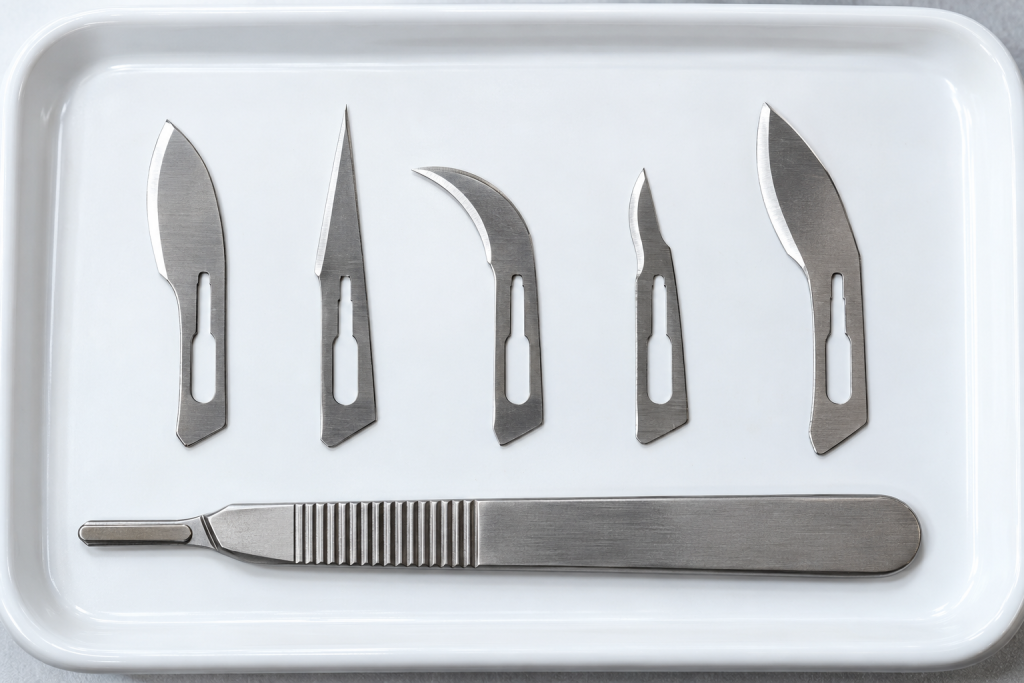
Scalpel blade sizes are really blade numbers: each number is a shape, and each shape is made for one of two handle fittings. Pick the number for the job, then pick the handle that carries it. This page has the full chart for the blades we stock, a quiz that does the matching for you, and the fit rules in plain terms.
Sterility note: only our blade 10-packs and our disposable scalpels are supplied sterile. Handles and craft knives are not sterile. Nothing here is sold as a medical device, and the quiz does not recommend any use on people.
Scalpel blade sizes chart
Swann Morton, the Sheffield maker whose numbering most catalogs follow, groups surgical blades into two ranges. Shapes 6 to 16 (plus the double-edged 40) are its No. 3 range, made for No. 3 fitment handles. Shapes 18 to 36 are its No. 4 range, made for No. 4 fitment handles (Swann Morton product range pages, read 10/22/2026). The chart below keeps to the blades in our store and uses the maker’s own descriptions of each shape.
The No. 3 handle blades
| Blade | Shape (per Swann Morton) | Handle | Typical use in our store |
|---|---|---|---|
| #10 | Curved cutting edge, one of the more traditional blade shapes | #3 (also #7) | General cutting, leather, dissection |
| #11 | Elongated triangle, sharpened along the long edge, strong pointed tip | #3 (also #7) | Precise point work, electronics, models, stencils |
| #12 | Small, pointed, crescent shaped, sharpened on the inside of the curve | #3 (also #7) | Hooked cuts, trimming, cutting thread and suture material |
| #15 | Small curved cutting edge, the most popular shape | #3 (also #7) | Short, precise cuts, suture practice, small specimens |
| #15C | Longer, more extended cutting edge than the #15 | #3 (also #7) | Fine cuts that need a little more reach |
The No. 4 handle blades
| Blade | Shape (per Swann Morton) | Handle | Typical use in our store |
|---|---|---|---|
| #18 | Part of the No. 4 range; no shape description on the maker’s page | #4 | Large work on the #4 handle |
| #20 | Large version of the #10, curved edge, flat unsharpened back | #4 | Large specimens, heavy cutting |
| #21 | Large version of the #10, larger than the #20 and smaller than the #22 | #4 | Large specimens, heavy cutting |
| #22 | Large version of the #10, larger than the #20 and #21 | #4 | Large specimens, necropsy, anatomy labs |
| #23 | Leaf shaped, sharpened along its leading edge | #4 | Long cuts, skinning, taxidermy, leather |
| #24 | More semicircular than the #23, sharpened along its leading edge | #4 | Long cuts on large specimens |
| #25 | Straight cutting edge and a sharply angled back, similar to a #11 but much larger, per Swann Morton | #4 | Large work on the #4 handle |
Why there is no length column
Swann Morton does not publish an edge length for these shapes on its product pages, so we do not print one. If you need a blade of a certain length, compare the shape descriptions above and check the listing before you order.
Which blade do I need? (quiz)
Two questions: what you are cutting, and whether you already own a handle. The quiz returns the blades in order of best fit, the handle that carries them, and the product to buy. If you have no handle it points to a set (handle plus 10 blades). If you already have the right handle it points to blades only.
Blade finder
Find blades for your handle
Blade numbers follow one standard. Pick the handle you own, or start from the job.
I have this handle
Blades that fit a #3 handle:
Need a spare? #3 Scalpel Handle, Stainless Steel
Blades that fit a #4 handle:
- #1810 sterile blades
- #20Large curved edge
- #21Large curved edge
- #22Largest curved edge
- #23Leaf shaped
- #24Semicircular edge
- #25Straight edge, sharply angled back, much larger than a #11
Need a spare? #4 Scalpel Handle, Stainless Steel
Blades that fit a #7 handle:
Need a spare? #7 Scalpel Handle, Long Slim Stainless Steel
Start with a set: a stainless handle plus 10 sterile blades of one number.
- #11 set#3 handle + 10 blades
- #10 set#3 handle + 10 blades
- #15 set#3 handle + 10 blades
- #23 set#4 handle + 10 blades
- #22 set#4 handle + 10 blades
- #20 set#4 handle + 10 blades
Or skip the handle: sterile disposable scalpels, ready to use.
Or start from the job
- 1
Match the handle
A #3 handle takes the smaller blades, #10 to #15. A #4 handle takes the larger blades, #20 to #25.
- 2
Pick the shape
#11 is the pointed blade for fine, precise cuts. #10 and #23 are curved for longer strokes. #15 is a small curved blade for detail work.
- 3
Change blades safely
Use pliers or a blade remover, never your fingers, and keep used blades in a sharps container.
What the quiz covers
The jobs are suture practice on pads and models, small and large dissection, taxidermy, leather, electronics, scale models, paper and stencils, clay, wood carving, everyday carry and single-use blades. The job-to-blade matches are our own, not a maker’s claim, and they stay a starting point: a different technique can call for a different shape.
Used blades
Any recommendation with loose blades also shows our blade disposal box. Keep a safe place for used blades rather than the bin or a drawer.
Blades for a #3 handle
Swann Morton lists blade shapes 6 to 16 and the 40 as made for No. 3 fitment handles, and says the #10 fits handles 3, 3L, 3 Graduated, 5B, 7, 9 and B3. The slim #7 handle takes the same blades as the #3. From our range, the blades for a #3 handle are the #10, #11, #12, #15 and #15C.
Small cuts and precision work
The #11 and #15 are the usual pair for detail. The #11 gives you a pointed tip, the #15 a small curved edge for short, controlled cuts. See every option on our page of blades for a #3 handle.
A handle to carry them
Browse scalpel handles for the #3 and #7. If you are starting from nothing, a set saves a step, see scalpel sets and kits. You can also filter the store to one number, for example the #11 blades, or to one handle, everything that fits a #3.
Blades for a #4 handle
The same maker lists shapes 18 to 36 as made for No. 4 fitment handles, and its No. 4L and No. 6B handles take the same blades. These are the large blades. From our range, the blades for a #4 handle are the #18, #20, #21, #22, #23, #24 and #25.
Which one for which job
For large specimens and heavy cutting, start with the #22 or #23. Swann Morton describes the #20, #21 and #22 as large versions of the #10, with the #22 the largest of the three. Swann Morton describes the #23 as leaf shaped and sharpened along its leading edge, which is why we list it first for skinning and leather. See all blades for a #4 handle.
Do not put a #4 blade on a #3 handle
The two fittings are different, and the maker lists each blade against its own handles only. Match the number to the handle first.
Do all scalpel blades fit the same?
No. Surgical blades come in two fittings, No. 3 and No. 4, and each blade fits only handles of its own fitting. In our store the #10, #11, #12, #15 and #15C go on the #3 and #7 handles, and the #18 to #25 go on the #4. Our craft knives come with their own handles and blades, so treat them as a separate line. See the arts and crafts range if that is what you need.
The quick rule
Blade number 6 to 16: #3 fitment. Blade number 18 and up: #4 fitment. Check this against the chart above, and when a listing names the handle it fits, trust the listing.
Frequently asked questions
No. Surgical blades come in two fittings. Shapes 6 to 16 are made for No. 3 fitment handles and shapes 18 to 36 for No. 4 fitment handles, according to Swann Morton's product range pages. In our store the #10, #11, #12, #15 and #15C go on the #3 and #7 handles, and the #18 to #25 go on the #4 handle.
Swann Morton lists blades 18, 19, 20, 21, 22, 22A, 23, 24, 25, 25A, 26, 27 and 36 as fitting its No. 4 fitment handles. From our range, that is the #18, #20, #21, #22, #23, #24 and #25.
Swann Morton describes the #15 as having a small curved cutting edge, the most popular shape for short, precise cuts, and the #10 as one of the more traditional curved shapes. Both fit the same #3 handle. We do not publish edge lengths because the maker does not.