Guide
#12 Scalpel Blade: What It Is Used For, Handle Fit (vs #11 and #15)
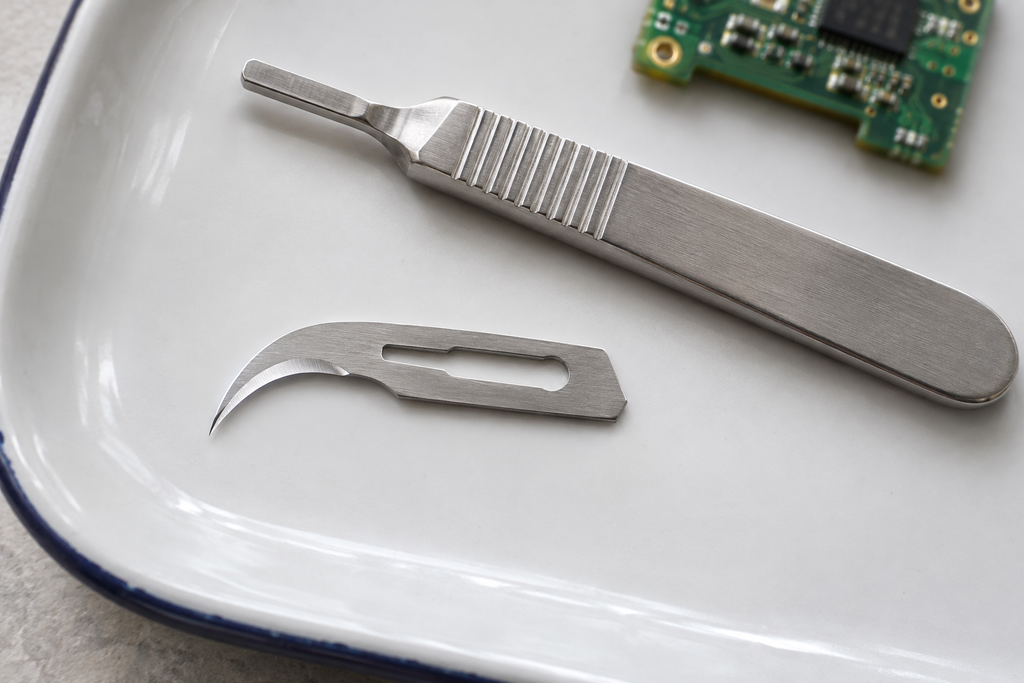
The #12 is a small crescent hook: a pointed blade sharpened on the inside of the curve, so it cuts as you pull it toward you. It fits #3 and #7 handles, not the #4. Need a straight point instead of a hook? Use a #11.
Not medical advice. We quote the maker on how surgeons use the #12 only to explain the shape. Our blades are sold for craft, hobby, study and dissection, not as medical devices.
The #12 blade at a glance
| Spec | #12 scalpel blade |
|---|---|
| Shape | Swann Morton: “a small, pointed, crescent shaped blade sharpened along the inside edge of the curve” |
| Fitting | No. 3 range (blade shapes 6 to 16) |
| Fits these handles | #3 and #7 in our store. Swann Morton lists handles 3, 3L, 3 Graduated, 5B, 7, 9, B3 and B3L. |
| Does not fit | #4 handle |
| Same shape, bigger | None. The #12 is the only hook shape in our range, so there is no #4 twin. |
| Our packs | Carbon steel, 10 blades, each in its own sterile foil pouch (gamma radiation, as declared by the manufacturer) |
| Edge length | Not published by the maker, so we do not print one |
You may also see a #12D in search results. It is a related Swann Morton shape listed next to the No. 12, and we do not sell it.
What a #12 blade is used for
The hook is the point. Because the edge is on the inside of the curve, you slip the tip under or behind what you want to cut and pull. That reaches places a straight edge cannot, and it cuts without pushing the point forward.
| Job | Why the #12 works | Also look at |
|---|---|---|
| Electronics, PCB and phone repair | Pulling cuts: lift a trace, slice a bridge or trim a gasket without pushing the tip into the board | #11 for straight point work |
| Clay and sculpture | Undercuts and hooked cuts behind a form | #11 for fine lines, #15 for small curves |
| Single-use, fresh edge every time | Sterile disposables with nothing to fit | The disposables in the shop section below |
In surgery, Swann Morton says the No. 12 “is sometimes utilised as a suture cutter” and lists incisions such as arteriotomies and mucosal cuts (Swann Morton No. 12 product page, read 11/11/2026). That is the maker’s description of clinical use, not a use we sell for.
#12 vs #11 vs #15
All three fit the same #3 handle, so the choice is only about the cut. This is the one to read if you are deciding between the hook and the straight point.
| Blade | Shape | Best for |
|---|---|---|
| #12 | Small crescent hook, sharpened on the inside of the curve | Pulling cuts, undercuts, hooking under a trace or edge |
| #11 | Elongated triangle with a strong pointed tip | Piercing, corners and straight point work |
| #15 | Small curved edge, the maker’s most popular shape | Short, precise cuts |
The quick rule: if you need to pull a cut toward you, take the #12. If you push or pierce, take the #11. If you slice a small curve, take the #15. More on the straight point in our #11 blade guide, and the full chart for every number is in our scalpel blade sizes guide.
Which handle fits a #12 blade?
A #12 goes on a #3 handle, the standard flat handle, or the #7 handle, which is longer and slimmer. It will not lock onto a #4 handle: the No. 4 fitting is larger. More on fittings in our scalpel handle sizes guide.
Shop #12 blades
No handle yet? Take the set. Have a #3 or #7? Take the blade pack. Want a fresh edge with nothing to fit? Take the disposables.
-
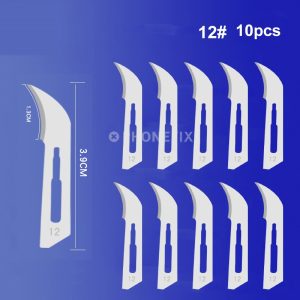
#12 Scalpel Set: #3 Stainless Handle + 10 Sterile #12 Blades
#12setScalpel Sets#3 handle + 10 sterile #12 blades. $15.99 Add to cart -
#12 Scalpel Blades, Sterile Carbon Steel (Pack of 10)
#12bladesBlades for #3 Handles10 sterile blades. Fits #3 and #7 handles. Original price was: $14.99.$12.99Current price is: $12.99. $1.30 per bladeAdd to cart -
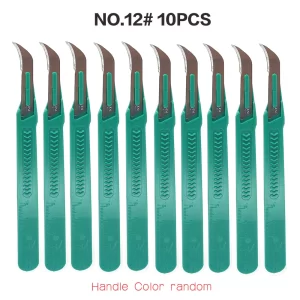
#12 Sterile Disposable Scalpels, Box of 10
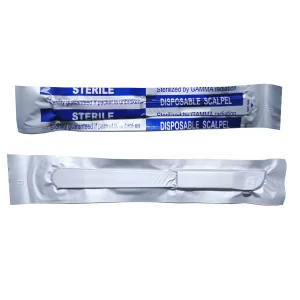
#12disposableDisposable ScalpelsBox of 10, sterile, handle built in. Nothing to fit. $19.99 $2.00 per scalpel100+ sold worldwideAdd to cart
Fitting and changing a #12 safely
- Fit and remove blades with pliers or a blade remover, never your fingers.
- Carbon steel can rust: dry the blade after use and store it dry.
- Drop used blades into a blade disposal box, never the bin.
- The #12 cuts on the pull. Cut away from the hand that holds the work, keep your fingers out of the path of the hook, and never pull toward your body.
Frequently asked questions
The #12 is a small crescent-shaped hook blade, sharpened on the inside edge of the curve. In our store it is used for pulling cuts in electronics and PCB repair, and for undercuts in clay and sculpture. Swann Morton adds that in surgery it is sometimes used as a suture cutter (Swann Morton No. 12 product page, read 11/11/2026). It fits #3 and #7 handles.
The inside. Swann Morton describes it as sharpened along the inside edge of the curve, which is why it cuts as you pull it toward you.
No. The #12 belongs to the No. 3 fitting and fits #3 and #7 handles. There is no #4 version of the hook in our range. For the blades that do fit a #4 handle, see our blade sizes guide.
The #12D is a related hook shape in Swann Morton’s range, listed alongside the No. 12. We do not sell it, so check the maker’s own page for its exact shape before you buy one elsewhere. The #12 we sell is the standard hook with the edge on the inside of the curve.
The #11 is a straight, pointed triangle for piercing and fine point work. The #12 is a hook sharpened on the inside of the curve for pulling cuts. Both fit the same #3 handle.