Guide
Scalpel vs X-Acto Knife: Which Should You Use?
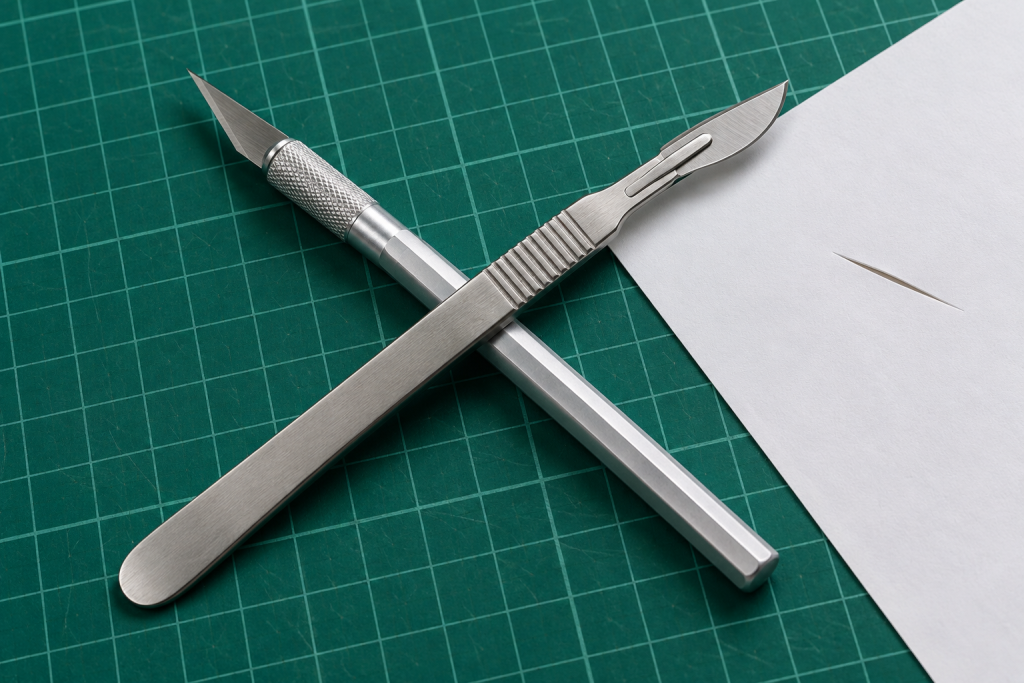
A scalpel and an X-Acto style hobby knife do the same basic job, which is making small, controlled cuts. The difference is in how the tool is built. A scalpel takes a thin, sharp, numbered blade on a steel handle and is designed around changing that blade often. A hobby knife usually takes a sturdier blade in a lighter handle and is designed to be cheap, familiar and forgiving. Choose a scalpel when fine detail and a fresh edge matter most. Choose a hobby knife when you want a robust blade for general cutting and do not mind it being a little less delicate.
X-Acto is a registered trademark of its owner, and we use the name here only for comparison. Everything we say about their blades comes from xacto.com. Everything we say about scalpels comes from our own catalog.
Blade geometry and sharpness
What a scalpel blade is
Scalpel blades are sold by number, and each number is a shape. The #11 is the pointed, straight-backed blade most makers reach for first. The #10 has a curved belly, the #15 is a small curved blade for short controlled cuts, and the #23 is a larger curved blade for long cuts. Our scalpel blade sizes guide walks through every number and which handle it fits.
Our scalpel blades are carbon steel, which is why they cut so cleanly through thin or delicate material. The trade-off is that a fine point is more fragile if you twist it or use it to pry.
What a hobby knife blade is
X-Acto lists its blades on its knives and blades page by model number: #11, #2, Z-Series #11, Z-Series #2, #10, #16, #17, #18 and #28. The same page says the blades cut a wide variety of surfaces, from paper to wood to plastic. That range makes a hobby knife a practical choice when the material is tougher or the cut is rougher.
Which one is sharper
We do not publish sharpness figures, because there is no single number that settles it and we would rather not invent one. Sharpness depends on the blade, the steel, how new it is and what you cut. A fresh blade beats a used one whatever its brand. For a fair test, compare two fresh blades on the same material.
The #11 is where the two worlds overlap. A #11 scalpel blade and a hobby knife #11 blade share a name because a pointed blade with a straight back is a useful shape for precision work. They are not interchangeable, however. Each fits its own handle, so check the handle before you buy blades.
Handles and grip
The #3 handle
The #3 is the stainless steel handle for the smaller blades, including the #10, #11, #12, #15 and #15C. It is flat and slim, and the blade slides onto its tip. Our #3 handle costs $12.99. Because it is steel it is easy to clean and sits steadily in the hand, but it is thin, and some people find a thin handle tiring over a long session.
The hobby knife handle
Hobby knives usually come with a round or knurled aluminum handle that clamps the blade at the tip. A round barrel is easier to roll between your fingers when you cut curves, and the knurling helps with grip. Soft-grip versions add comfort for long sessions. Our arts and crafts knives are built this way and use #11 blades.
Choosing by grip
If you hold the knife like a pencil, a round handle is usually the more comfortable. If you cut with a steady, flat motion and swap blade shapes often, the #3 gives you more shapes to choose from. You can see every handle on our scalpel handles page.
Blade cost and swaps
Our prices
These are our listed prices as of October 2026, and they can change.
- #11 scalpel blades, pack of 10: $12.99 (about $1.30 per blade).
- #11 craft knife with a knurled aluminum handle and 11 blades: $11.99.
- #11 craft knife blades, high carbon steel, in quantities of 100, 200 or 300: from $14.99. See the arts and crafts blades.
If you only need a handful of blades for occasional work, a craft knife with blades included is the cheapest way in. If you work through blades quickly, a bulk pack of craft blades gives the lowest cost per blade.
X-Acto pricing
The xacto.com knives and blades page does not list prices, so we will not quote any. Check current pricing with whichever retailer you use.
Swapping a blade
On a scalpel, you slide the blade on and off the handle, ideally with forceps or a blade remover, never with your fingers. On a hobby knife, you loosen the clamp, pull the blade out and fit the new one. Both are quick once you have done it a few times. Our #11 blade listings show which products take that blade.
Which to use for papercraft, models, leather and electronics
These suggestions follow the blade recommendations in our own store guide. They are starting points, not rules.
Papercraft and stencils
A #11 blade is the usual choice for paper, card, stencils and vinyl. A hobby knife handle is the comfortable way to run it, and cheap replacement blades matter because paper dulls an edge quickly.
Scale models and miniatures
The #11, #15 and #10 are the blades we suggest for scale models, usually on a long slim #7 handle that gives you reach into tight spots. A hobby knife is also a sensible choice for trimming and cleaning up parts.
Leather
For leather we suggest the #23 on a #4 handle, or the #10 or #11 on a #3 handle. The larger #23 gives you long cutting strokes. A hobby blade can work on thin leather, but a scalpel gives you more blade shapes to choose from.
Electronics and repair
For circuit board and phone repair work, the #11, #15 and #12 on a #3 handle are the blades we suggest. The fine point is useful for slicing adhesive and cutting small traces. Unplug devices before you work on them.
Safety: new blades and disposal
Use a fresh blade
A dull blade needs more force, and more force means slips. Change blades as soon as the cut starts to drag or tear. Always cut away from your hand, keep the other hand out of the path of the blade, and cut on a proper mat.
Sterile or not
Our 10-blade packs and disposable scalpels are supplied sterile. Handles and craft knives are not sterile. Nothing we sell is a medical device, and we do not sell anything for use on people.
Disposing of used blades
Never drop loose blades in the trash or put them back in a drawer. Use a rigid container with a lid, and keep used blades in it until it is full. Our blade disposal box ($12.99) has a built-in blade snapper, so you can remove a used blade without touching it. Local disposal rules for sharps vary, so check yours.
Frequently asked questions
There is no single answer, and we do not have a measured comparison to quote. Sharpness depends on the steel, the grind and how new the edge is. Both can be extremely sharp when new, and both lose their edge with use. Compare fresh blades on the same material if you need to decide.
A scalpel is a small cutting tool with a thin, numbered blade, usually fitted to a steel handle, and made for precise cuts. A knife is a broader term for cutting tools of every size. A hobby knife sits between the two, with a small pointed blade and a lighter handle. For precision work the difference comes down to blade shape choice and how often you change the blade.
X-Acto lists its blades by model number rather than by size. The xacto.com knives and blades page names the #11, #2, Z-Series #11, Z-Series #2, #10, #16, #17, #18 and #28. The page says they cut materials from paper to wood to plastic, but it does not give measurements, so check the maker's packaging for dimensions.