Guide
Dermaplaning vs Shaving: What Is Different and Which to Choose
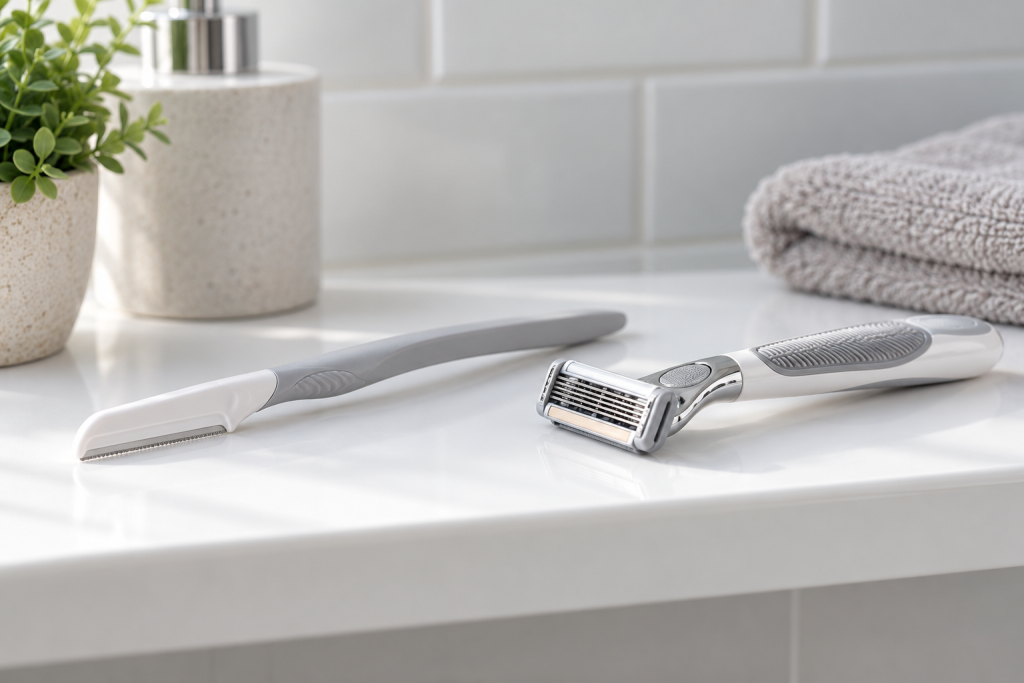
Dermaplaning and shaving both pull a blade across the face to remove fine vellus hair, the “peach fuzz,” so they look alike. The difference is the blade, the technique and the goal. Dermaplaning uses a single straight blade, a scalpel or a dermaplaning razor, drawn in light strokes to take off hair and the top layer of dead skin cells. Shaving with a razor is aimed at the hair alone. This guide compares the two, with the dermatology source named wherever we make a claim about skin.
Two notes before we start. We are a blade retailer, not a clinic, and nothing here is medical advice. If you have a skin condition, ask a dermatologist first. And our blades are sold as tools: the blade size guide explains the shapes, and the packs that ship sterile are marked as such on their product pages.
The blade
Scalpel or dermaplaning razor
Cleveland Clinic describes dermaplaning as a procedure that uses a scalpel or a razor to remove the outer layer of skin (Cleveland Clinic, “Dermaplaning: What It Is, Benefits & Side Effects,” last updated April 6, 2022). Harvard Health says the same about the home version: “All dermaplaning tools involve a type of razor or scalpel” (Harvard Health, “Is it safe to dermaplane my face?”, November 19, 2025). The tool is a single sharp edge on a handle, which is why a surgical-style blade on a scalpel handle is a common choice.
The multi-blade razor
A standard face or body razor is built for another job. Japonesque, a dermaplaning razor brand, contrasts the single straight edge of a dermaplaner with a standard razor that often has three or more blades lined up together and is used with water and shaving cream or gel (Japonesque Edit, October 13, 2026). This is a brand source, so treat it as a description of the tools, not a medical finding.
Angle and stroke
Healthline, in an article medically reviewed by Cynthia Taylor Chavoustie, MPAS, PA-C, describes dermaplaning as using a blade held at a 45-degree angle, and says its basic concept is the same as shaving (Healthline, published March 27, 2019). That is the honest summary: the motion is similar, and the single sharp edge and the scraping intent are what set dermaplaning apart.
To match a blade to a handle, see the scalpel blade size guide and our dermaplaning page. The #10R and the #14 are common dermaplaning blades. We do not sell those two; we sell the #10, a standard blade with a broad curved edge that is also used for dermaplaning, as sterile #10 blades in packs of ten and as a #10 set with a #3 handle.
What each removes
Dermaplaning: hair plus dead skin
Jeffrey Sassmannshausen, MD, of Three Rivers Dermatology writes that dermaplaning “scrapes away dead skin cells from the face” along with fine vellus hair (Three Rivers Dermatology blog, June 14, 2021). Japonesque puts the distinction in plainer words: “Shaving isn’t designed to exfoliate. It trims hair at the surface” (Japonesque Edit, October 13, 2026).
Shaving: hair at the surface
The Three Rivers post says shaving removes unwanted facial hair but “doesn’t go nearly as far in terms of exfoliating and renewing the face.” Shaving is also the tool most people already own and know how to use.
How long it lasts, and stubble
Cleveland Clinic notes that dermaplaning for hair removal is only temporary because the hair grows back. On stubble, Cleveland Clinic’s Taylor Bullock, MD, a dermatology resident, explains why any cut hair can feel rough: short hairs “can feel stubbly or stiff because their shorter lengths have increased resistance to bending forces,” and moisturizing helps, since “the drier your hair is, the pricklier it will feel” (Cleveland Clinic, January 11, 2023). The same applies to a hair cut with a razor or a scalpel.
Does hair grow back thicker?
This is the most common worry, and the dermatology sources we opened say no. Dr. Bullock at Cleveland Clinic: “Shaving won’t make your hair regrow any thicker or faster,” and “shaving doesn’t impact how quickly your hair regrows” (January 11, 2023). The article says regrowth can look thicker and darker at first and attributes that to the variation of the hair shaft along its length, not to a change in the follicle. Sassmannshausen at Three Rivers Dermatology says of a close shave that it “does not cause the facial hair to grow back thicker or darker” (June 14, 2021).
Both statements are about shaving. Cleveland Clinic’s own dermaplaning page does not answer the question and lists it as something to ask your provider, so if you are worried, that is the conversation to have. For routine, see our guide to how often to dermaplane.
Which to choose
Sensitive skin
Harvard Health states that people with sensitive skin, or skin conditions such as rosacea, eczema or acne, should avoid dermaplaning (November 19, 2025). Japonesque, citing the same Harvard article, does not recommend it for sensitive skin and notes that frequent shaving can irritate as well. If your skin reacts easily, ask a dermatologist before choosing either.
Acne
Cleveland Clinic lists active acne first among the conditions for which people should talk to a provider before dermaplaning, along with cold sore outbreaks, eczema, psoriasis, moles and skin tags. Healthline says an active acne flare-up may mean rescheduling a professional session.
Risks to know
Cleveland Clinic lists infection, scarring and lighter or darker skin discoloration as risks of the procedure, and says skin is typically red, swollen and slightly tender afterward. Healthline adds slight redness for a few hours and, for some people, whiteheads a day or two later, and says home dermaplaning may carry higher risks than a professional session. Harvard Health’s main point for home use is the risk of nicking the skin, and its advice is a new, clean blade each time.
A simple way to decide
If you only want the hair gone, quickly, with a tool you own, shaving does that. If you want the exfoliation as well and your skin is not on the lists above, dermaplaning is the option the sources describe, with a clean single-use blade and a gentle hand. If you are not sure, ask a dermatologist. Our how to dermaplane at home guide covers the process step by step.
Dermaplaning vs waxing
Waxing is a different method with a different tool, so it sits outside what we sell and what we can source. The point worth keeping from the dermatology pages above is the one Cleveland Clinic makes about dermaplaning: hair removal that way is temporary, and the hair comes back. Whichever method you pick, the sensitive-skin and active-acne cautions from Harvard Health and Cleveland Clinic are a good first filter, and a dermatologist can tell you what suits your skin.
Frequently asked questions
Any cut hair can feel a little rough as it grows back. Cleveland Clinic's Taylor Bullock, MD, explains that short hairs can feel stubbly or stiff because their shorter length resists bending, and that moisturizing helps. Fine vellus hair usually feels soft, but the smooth result is temporary.
The dermatology sources we opened say no for shaving. Cleveland Clinic (January 11, 2023) says shaving will not make hair regrow thicker or faster, and Three Rivers Dermatology (June 14, 2021) says a close shave does not make facial hair grow back thicker or darker. Cleveland Clinic's dermaplaning page does not address it directly, so ask your provider if you are concerned.
Cleveland Clinic lists infection, scarring and lighter or darker skin discoloration as risks, with redness and tenderness afterward. Harvard Health says people with sensitive skin, rosacea, eczema or acne should avoid it, and that the main home risk is nicking the skin. Hair removal this way is also temporary.
It is a personal choice. Peach fuzz is normal vellus hair, and nothing requires removing it. If you like the look of it removed, shaving and dermaplaning are two options, and the cautions above apply to both.