Guide
Dermaplaning Before and After: Prep, What to Expect and Aftercare
Dermaplaning before and after comes down to three things: skin that is calm and clean before you start, red and tender skin for a few hours to a day afterward, and hair that comes back because the effect is temporary.
This is a timeline guide, not a photo gallery. We are a blade store with no clinic, so we have no before and after photos, and we will never fake them.
Not medical advice. Every skin claim below is attributed to a named source with its date. Where we could not open a source that answers a question, we say so. If you have a skin condition, ask your dermatologist first.
Before: how to prep your skin
Cleveland Clinic’s patient page on dermaplaning (last updated April 6, 2022) says people with an active case of acne or cold sore outbreaks should not have the procedure, and lists eczema, psoriasis and contact dermatitis as conditions to discuss with a provider first. So the first step of prep is a check, not a product.
- Check the skin. No breakout, rash, cold sore, cut or sunburn. Cleveland Clinic dermatologist Melissa Piliang, MD, says to skip it during a breakout or an eczema flare-up (Cleveland Clinic Health Essentials, June 13, 2022).
- Cleanse and pat dry. Wash with a gentle cleanser and dry the skin completely, so you can see the fine hair clearly. This is our tool-side practice, not a dermatology finding.
- Do it in the evening, not before an event. Cleveland Clinic says skin is typically red, swollen and slightly tender afterward, so leave a night between the blade and anything important. That is our reading of its description.
- Skip new products that day. We found no dermatology source with a rule for combining retinoids or acids with dermaplaning. If you use prescription retinoids or have in-office treatments, ask whoever prescribes them.
- Start with a fresh, clean tool. Cleveland Clinic advises cleaning the razor before and after each use, because cuts can lead to infection. Fit the blade on a stable surface, never over your face.
The full method, step by step, is in our how to dermaplane at home guide.
Right after: what to expect
These are the effects the named sources describe. Timings are theirs, and your skin may differ.
| Time | What you may see | What to do |
|---|---|---|
| First hours | Slight redness. Healthline, in an article medically reviewed by Cynthia Taylor Chavoustie, MPAS, PA-C (March 27, 2019), describes slight redness for a few hours. Cleveland Clinic describes skin that is typically red, swollen and slightly tender after the in-office procedure. | Rinse with lukewarm water, pat dry, moisturize. Dr. Piliang advises moisturizing well and continuing to wear sunscreen. |
| Around a day | Dr. Piliang says the skin may feel a little irritated for a day or so afterward (June 13, 2022). | Keep the routine plain. Skip anything that stings. |
| A day or two | Healthline adds that some people get whiteheads a day or two later. | Do not pick. If a breakout builds, see the dermatologist section below. |
| Following days | Smoother-feeling skin and no visible fine hair, by the design of the technique. The hair is cut, not removed at the root. | Sunscreen every day. Cleveland Clinic’s page on the in-office procedure says to stay out of the sun while treated skin heals. |
The sun advice comes from the page on the deeper in-clinic treatment, so we use it only as a general reminder, not as a home recovery timeline.
The days and weeks after
Here is what the sources say about the longer run, and where they stop.
- It is temporary. Cleveland Clinic notes that dermaplaning for hair removal is only temporary because the hair grows back.
- Regrowth speed. We did not find a named source that gives a regrowth timeline in days or weeks, so we do not print one. The nearest hard number is the interval for professional sessions: Plastic Surgery Centre of Atlanta (July 29, 2024) writes that “on average, it’s best to dermaplane your face every three to four weeks.” That is a scheduling figure, not a measure of regrowth.
- Thicker or darker? Dr. Piliang calls it a myth: “trimming off the hair above the surface of the skin has no effect on how the hair grows” (June 13, 2022). On stubble and regrowth, see dermaplaning vs shaving.
- How soon to repeat. At home, Dr. Piliang says she would not do it more than once a week so the skin can recover. Intervals and signs of overdoing it are in how often should you dermaplane.
We do not promise results. What you see depends on your skin, your hair and your technique, and no source we read guarantees an outcome.
What not to do after dermaplaning
No single dermatology page we read lists a full set of rules. This is what we can attribute:
- Do not skip sunscreen. Dr. Piliang advises continuing to wear it after dermaplaning (Cleveland Clinic, June 13, 2022).
- Do not repeat a session early. Cleveland Clinic’s patient page says the skin must heal fully between sessions.
- Do not dermaplane more than weekly at home. Dr. Piliang sets that ceiling so the skin has time to recover.
- Do not reuse a used blade. Harvard Health’s advice for home use is a new, clean blade each time (November 19, 2025). Drop the old one into a blade disposal box.
- Do not add products that sting or irritate. That is our rule of thumb for freshly treated skin, not a quoted finding. For anything specific, such as acids or retinoids, ask a dermatologist.
When to stop and see a dermatologist
- Redness or irritation that lasts well beyond a day.
- A cut that looks infected. Cleveland Clinic says cuts can lead to infection.
- A breakout after a session. Cleveland Clinic’s dermatologist says dermaplaning can worsen acne.
- Scarring or lighter or darker patches of skin. Cleveland Clinic lists infection, scarring and skin discoloration among the risks of the procedure.
- Any pre-existing skin condition, before you start at all. Harvard Health states that people with sensitive skin, or conditions such as rosacea, eczema or acne, should avoid dermaplaning (November 19, 2025).
Persistent problems are a reason to see a dermatologist, not to try a different blade.
The blade we sell for it
For dermaplaning we sell the #10, a standard scalpel blade with a broad curved cutting edge, and the #3 handle it fits. The #10R and the #14 are also common choices, and we do not sell those two. Everything is on one page: dermaplaning blades, handle and set.
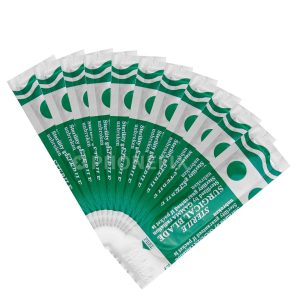
Our blades are sold as tools, not as medical devices. Only the packs of 10 blades and the disposables are supplied sterile, as stated on their product pages.
- Bestseller
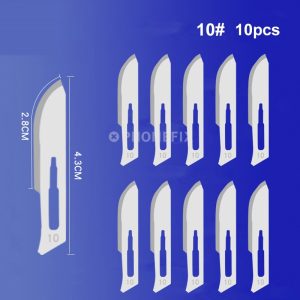
#10 Scalpel Set: #3 Stainless Handle + 10 Sterile #10 Blades
#10setDermaplaning#3 handle + 10 sterile #10 blades. Original price was: $17.99.$15.99Current price is: $15.99. Add to cart -
#10 Scalpel Blades, Sterile Carbon Steel (Pack of 10)
#10bladesBlades for #3 Handles10 sterile blades. Fits #3 and #7 handles. Original price was: $14.99.$12.99Current price is: $12.99. $1.30 per bladeAdd to cart -

#3 Scalpel Handle, Stainless Steel
#3handleDermaplaningTakes blades #10, #11, #12, #15 and #15C. Original price was: $14.99.$12.99Current price is: $12.99. Add to cart
Frequently asked questions
Cleveland Clinic dermatologist Melissa Piliang, MD (2022) advises moisturizing and continuing to wear sunscreen, and says to give the skin time to recover, with no more than one session a week at home. Harvard Health (2025) advises a new, clean blade each time. We would add: do not put anything on the skin that stings. We did not find one source that lists every rule, so ask a dermatologist about acids and retinoids.
Nothing but a gentle cleanser, then a completely dry face, is our practice, so you can see the hair and the edge clearly. We found no dermatology source that recommends a specific product, oil or cream before dermaplaning, so we do not name one. If you use prescription retinoids or acids, ask whoever prescribes them first.
We could not find a named source that identifies it, and it is not something our tools need. It may be a cream, gel or mask used by some providers or brands. Cleveland Clinic mentions a gel or ointment used afterward in a clinical setting to reduce redness, swelling or irritation. If a provider offers a product, ask what it is and why before it goes on your skin.
Any cut hair can feel a little rough as it grows back. Cleveland Clinic dermatology resident Taylor Bullock, MD (January 11, 2023), explains that short hairs can feel stubbly because their shorter length resists bending, and that moisturizing helps. More in our dermaplaning vs shaving guide.
Yes. Cleveland Clinic (2022) names irritation for a day or so, cuts that can become infected, and a risk of worse acne. Its page on the in-office procedure also lists infection, scarring and skin discoloration. Harvard Health (November 19, 2025) says people with sensitive skin, rosacea, eczema or acne should avoid it. The hair removal is also temporary.
We found no dermatology source that answers this, so this is our editorial answer. A shower first is fine as long as you dry the skin completely before the blade touches it, because fine hair is easier to see on dry skin. Afterward, rinse with lukewarm water, pat dry and moisturize. If you are unsure, ask a dermatologist.